
2025年12月30日

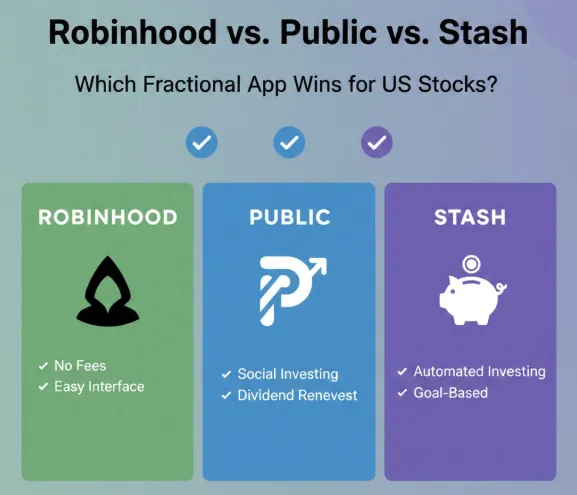
Robinhood vs. Public vs. Stash: Which Fractional App Wins for US Stocks?

Fractional investing apps let you buy a slice of a US stock for just a few dollars, making blue-chip names accessible without saving for a full share. If your goal is simple, low-cost exposure to US stocks with fractional shares, Robinhood is the best fit for most beginners thanks to $0 trading commissions, $1 minimums, and easy recurring buys. Public serves as a strong alternative if you want a social, research-forward experience. Stash is designed for hands-off beginners who prefer automated portfolios and banking-style features, though its monthly subscription can outweigh benefits on small balances. Below, we compare the three apps on fees, minimums, usability, and who each is best for—so you can start with as little as $1 and build a diversified portfolio over time. Overview of Fractional Investing Apps for US Stocks Fractional shares allow you to purchase a portion of a stock or ETF by dollar amount rather than whole shares. This lowers the barrier to entry—many leading apps support minimums as low as $1, which aligns with findings in Bankrate’s guide to fractional-share brokers that highlight dollar-based investing and low starting amounts across top platforms. Fractional orders typically execute like market or recurring buys during market hours, and most brokers credit dividends proportionally on your holdings. Voting rights on fractional shares vary by broker and are often limited to whole-share ownership, a nuance covered in StockBrokers.com’s explainer on fractional-share brokers. Below is a side-by-side look at Robinhood, Public, and Stash for US stock investing with fractional shares. NerdWallet’s roundup of brokers with fractional shares corroborates that all three offer dollar-based investing in US stocks and ETFs alongside beginner-friendly tools. StockBrokers.com’s beginner investing guide also stresses education and ease of use—areas where simple interfaces, recurring buys, and bite-sized research help new investors stay engaged. Our quick verdict: Best overall for fractional US stocks: Robinhood, for $0 commissions, low minimums, and seamless recurring investing. Best for research and community: Public, for social discovery and curated insights. Best for automation (but mind the fee): Stash, for set-and-forget portfolios with banking-style tools. Robinhood at a glance Robinhood made fractional shares mainstream by pairing $0 commissions with an interface that makes dollar-based buys and recurring investments easy. You can start with $1 per trade, build a US stock or ETF core, and add recurring schedules to automate contributions. For most cost-sensitive beginners, the lack of trading commissions and a clean onboarding flow stand out. If you plan to place frequent small orders, minimizing ongoing fees is critical—Robinhood’s pricing structure helps your returns compound without a monthly drag. Public at a glance Public layers fractional investing with a social feed, thematic collections, and light research to help beginners learn in context. You get $0 stock and ETF commissions and $1 minimums, plus optional premium features for deeper insights. If you value community, short-form commentary, and discovery tools that surface ideas, Public is compelling. The trade-off: optional add-ons can cost extra, so the best fit is investors who will actively use the research and community features. Stash at a glance Stash blends brokerage and banking-like tools—fractional shares, automated portfolios, recurring deposits, and round-up savings—behind a monthly subscription ($3–$9). The fee can be worthwhile if you rely on automation to save and invest consistently, but it poses a clear cost disadvantage for very small balances. If you prefer a guided, set-it-and-forget-it path with budgeting and saving tools under one roof, Stash is the most integrated of the three. How much do you need to start? You can begin investing in fractional US stocks with as little as $1 on Robinhood, Public, and Stash. That low threshold is a key reason fractional apps rank highly across expert lists that compare stock trading platforms for beginners. Editorial methodology Our comparison focuses on total cost to own (commissions plus ongoing plan fees), minimum investment thresholds, beginner usability (recurring buys, education, community), and breadth of US stock/ETF access. We cross-checked claims and best practices against independent editorial sources that research fractional-share brokers, including NerdWallet and Bankrate, and aligned functionality considerations with StockBrokers.com’s guidance for beginners. Where ToVest fits in If you’re exploring fractional ownership beyond traditional brokerages, ToVest brings blockchain technology to US equities and other real-world assets, enabling real-time execution windows, programmatic recurring buys, and diversified, tokenized portfolios. The goal is enhanced capital efficiency and global access while maintaining a familiar, dollar-based investing experience. For investors who want fractional US stocks today with a path to broader tokenized assets tomorrow, ToVest complements the options above. Quick FAQs How much can I start with? Typically $1 per trade on these apps; start small and automate contributions. Do fractional shares pay dividends? Yes, dividends are credited proportionally to your fractional ownership. Do I get voting rights on fractional shares? Voting rights are often limited or not provided for fractional positions; whole shares generally carry voting privileges. Are there monthly fees? Robinhood and Public can be $0 for core trading, while Stash charges a $3–$9 monthly subscription. Which app is best for beginners? For pure US stock buying with minimal ongoing costs, Robinhood is ideal. If you want community and research, Public is a strong choice. For those who prefer automation and banking-style tools, Stash is suitable. What’s the best fractional investing app for US stocks? For most cost-focused beginners, Robinhood wins; Public is the runner-up for social discovery, and Stash suits hands-off investors who value automation despite the fee.

blog banner

2025年12月9日

Expert Review: Evaluating Blockchain Providers for High‑Volume Tokenized Stock Trades

The future of investment is digital, and tokenized equities represent a major leap forward, merging traditional markets with blockchain efficiency. This expert review evaluates the best blockchain services for trading tokenized stocks, focusing on the infrastructure and security required for high-volume transactions. At ToVest, we understand that sophisticated investors—especially the Gen Z audience in Southeast Asia—demand transparent and reliable access to these assets. We prioritize advanced infrastructure to overcome the latency and accessibility limitations of traditional trading. Introduction to Tokenized Stock Trading Tokenized stocks are digital representations of traditional equities issued as blockchain tokens. They allow investors to trade fractional, real-world company shares on digital platforms. Tokenization is driving unprecedented growth; the global asset tokenization market, valued at $5.6 billion in 2024, is projected to hit $30.21 billion by 2034. This growth is fueled by tokenization's ability to: Enhance accessibility through fractional ownership. Increase transparency via on-chain records. Enable 24/7 trading, bypassing traditional market hours. Criteria for Evaluating Blockchain Providers Choosing the right platform for tokenized stock trading requires a rigorous evaluation checklist focused on performance and security: Transaction Speed (TPS): The platform must handle high volumes with low latency. High TPS (Transactions Per Second) is essential to minimize slippage and ensure timely execution. Cost Efficiency: Gas fees and overall transaction costs must be low to maintain profitability, especially for frequent traders. Platforms like Solana and Binance Smart Chain excel here. Security and Regulatory Compliance: Robust security protocols (e.g., proof-of-reserve, secure custody) and adherence to local financial regulations are non-negotiable for investor protection. Liquidity and Asset Range: The platform should offer deep liquidity for major tokenized equities and a wide range of popular stocks. ToVest’s Blockchain Approach for Tokenized Stocks ToVest is tailored to the needs of the modern, tech-savvy investor, focusing on the secure, fast, and transparent trading of Real-World Assets (RWA), including tokenized stocks and digital gold. Ultra-Low Latency: Our advanced infrastructure is designed for speed, ensuring immediate trade execution critical for high-volume traders. Industry-Leading Security: We integrate strong security protocols and partner with reputable payment providers, ensuring client assets are protected. Regulatory Awareness: We maintain a strong focus on regulatory compliance and investor safeguards, establishing trust in the evolving digital asset space. Top Blockchain Providers and Platforms for Tokenized Equities The landscape of asset tokenization platforms is dominated by networks offering a mix of speed, trust, and decentralization. Solana (SOL) Solana has rapidly become a top choice for high-volume digital trading due to its technical superiority. Core Advantage: Solana supports approximately 65,000 transactions per second (TPS), offering some of the fastest and most cost-effective trading for tokenized equities. Market Role: It is now the second-largest blockchain for tokenized stock trading, driven by its utility for perpetual contracts and 24/7 access via platforms like BackedFi. Caveat: While highly performant, Solana still faces occasional scrutiny regarding network stability and regulatory clarity compared to older networks. Kraken (Platform) Kraken is a highly trusted exchange offering seamless access to tokenized assets, making it an excellent crypto trading platform. Key Features: Offers tight spreads, averaging 0.25%, for popular tokenized stocks (e.g., Tesla, Apple) and strong liquidity, particularly during peak hours. User Experience: Known for its excellent user interface and smooth transfer capabilities between crypto and tokenized assets. Trade-off: Research tools may be less comprehensive compared to some traditional brokerage platforms. Coinbase (Platform) A market leader focused on security and accessibility, especially for mobile-first investors. Scale and Trust: With over 108 million users and $1 trillion in annual trading volume, Coinbase provides robust security and trust. Performance: Features an intuitive mobile interface and fast execution with spreads around 0.3%, allowing for seamless crypto-to-tokenized asset transfers. Trade-off: Can have higher fees than high-frequency alternatives, and its focus is broader than just tokenized stock trading. Ethereum (ETH) Ethereum remains the legacy platform, renowned for its security and vast ecosystem. Strengths: Its robust DeFi ecosystem and variety of token standards (ERC-20, etc.) make it a trusted foundation for large-scale, regulated asset tokenization. Drawbacks: Its Layer 1 network is relatively slow (approx. 30 TPS) and features high transaction costs, making Layer 2 solutions necessary for efficient high-volume trading. Binance Smart Chain (BSC) BSC offers a high-speed, affordable alternative tightly integrated with the world's largest crypto ecosystem. Value Proposition: Features rapid block times, low transaction fees, and efficient high-volume processing, making it popular among retail traders for cost efficiency. Usage: It's frequently used for tokenized assets due to its easy integration and developer-friendly tools. Side-by-Side Comparison of Blockchain Providers The following table summarizes the performance and cost trade-offs of the leading options for trading tokenized stocks. Key Considerations for Choosing a Blockchain Provider To maximize returns and security in high-volume trading, consider the following non-negotiable factors: Scalability: The platform must be able to handle sudden, massive spikes in trading volume without significant slowdowns or increased costs. Custody and Fiduciary Safeguards: Ensure the platform has transparent custody practices and proof of reserves to protect your client assets. Interoperability: Platforms that support cross-chain bridges or multiple networks (like ToVest) can enhance liquidity and allow for easier asset movement. Regulatory Commitment: Choose platforms demonstrating a clear commitment to regulatory compliance and investor protection in your operating jurisdiction. Conclusion The market for tokenized stock trading is rapidly maturing, offering performance that increasingly rivals traditional finance. Investors must carefully compare the underlying blockchain infrastructure to maximize accessibility, transparency, and efficiency. We encourage you to prioritize platforms like ToVest that demonstrate investor safeguards, cost effectiveness, and a clear regulatory commitment when engaging with tokenized equities. Frequently Asked Questions What are tokenized stocks and how do they work? Tokenized stocks are digital representations of real-world equity shares that can be bought, sold, and settled on a blockchain, offering fractional ownership and instant settlement. How do blockchain providers support high-volume tokenized stock trading? Blockchain providers optimize transaction speed (TPS), scalability, and liquidity to ensure the reliable, cost-effective trading of large volumes of tokenized stocks around-the-clock. Are tokenized stocks regulated and safe to trade? Regulation varies by jurisdiction. Reputable asset tokenization platforms use strong custody protocols, regulatory compliance measures, and security features to protect investors in the tokenized stock market. What factors determine the cost and speed of tokenized stock trades? Transaction speed and cost depend on the underlying blockchain’s capacity, its network fees (gas), and the platform's execution design. Faster and cheaper solutions, like Solana, are gaining popularity. Can tokenized stocks provide dividends and shareholder rights? Some tokenized stocks offer dividends and shareholder rights if they represent an actual share in custody. However, some may only provide price exposure without these specific benefits, so it is essential to check the platform’s offering.

blog banner

2026年2月3日

Buy Tokenized Real Estate in 2026: A Quick Start Guide

Tokenized real estate allows you to buy fractional interests in property using digital tokens, offering lower minimums and faster settlement than traditional deals. If you’re wondering how to buy tokenized real estate in 2026, the short answer is: choose a regulated platform, complete KYC, review legal documents, verify custody and fees, understand liquidity limits, and start small while monitoring results. This quick-start guide expands those steps into a practical playbook—what tokenization is, what to check before you invest, and how to evaluate platforms and offerings. Throughout, we reflect ToVest’s perspective: regulated market access, strong compliance, and operational rigor designed to make tokenized assets—including tokenized stocks and real estate—simple and secure for global investors. Understanding Tokenized Real Estate Tokenized real estate converts property ownership or related rights into digital tokens recorded on a blockchain. Think of a token as a digital deed or share certificate—it represents rights, while the property itself stays off-chain, as described in the RWA platforms guide for 2026 (RWA.io). In short, the blockchain acts as your ledger; the building remains in the real world. Real-world asset tokenization turns off-chain ownership rights into on-chain tokens connected to legal frameworks, as explained in a business guide to RWA tokenization (ChicMic Studios). In U.S. deals specifically, the token acts as a wrapper—investor rights are enforceable through the legal documents, not the ledger alone, according to a US real estate tokenization overview (Tokenizer Estate). Traditional vs. tokenized real estate at a glance: Preparing to Invest in Tokenized Real Estate Before you buy, run preflight checks. Confirm the legal claim you’re acquiring, your cashflow rights, any resale or transfer limitations, and the platform’s operational capabilities. Pay particular attention to investor eligibility, platform licensing, and the presence of Know-Your-Customer (KYC) and Anti-Money Laundering (AML) controls. Tokenization works best when treated as a securities-plus-operations product: legal terms, compliance, and servicing must align—not just token minting. Quick readiness checklist: Identify the legal structure and what the token represents (equity, debt, revenue share). Confirm investor eligibility and geographic restrictions. Verify KYC/AML, audit trails, and data retention. Review custody of tokenized assets and how on-chain records reconcile to off-chain registers. Understand fees, distribution cadence, and resale rules. Check the platform’s operational track record and support response times. Step 1: Review the Legal Offering Documents Your rights reside in the legal documents. Offering circulars, operating agreements, subscription docs, and transfer policies should clarify: What you legally own (fractional equity, profit participation, specific voting rights). Cashflow terms (rental income, interest, distributions, waterfalls). Transfer, resale, and exchange rules, including any holding periods and approvals. Exit scenarios, buyback rights, and dissolution procedures. If it isn’t clearly stated off-chain, assume it isn’t guaranteed. Tokens reflect these rights; they don’t replace them. Step 2: Verify Platform Licensing and Investor Eligibility Choose regulated platforms and issuers. Confirm registrations or exemptions relevant to your region (e.g., SEC regimes in the U.S., MiCA in the EU) and ensure the platform implements KYC/AML gating and maintains audit trails. The regulatory path (e.g., Reg D, Reg A, Reg CF) dictates who can invest, when tokens can be resold, and where they can trade. Expect to provide and receive: Identity verification (KYC), source-of-funds checks, and sanctions screening. Disclosures on conflicts, fees, and risk factors. Offering documents tied to the exemption being used (e.g., Reg D PPM, Reg A circular). Clear statements on transfer restrictions, lockups, and secondary access. Step 3: Confirm Custody and Insolvency Protections Custody—the safekeeping of your tokens and the linkage to the underlying legal asset—is crucial. Custody and safekeeping are central challenges, and traditional custodians are building wallet and smart contract capabilities, as noted in What is RWA tokenization (Investax). Custody risk is real: private keys can be lost, wallets compromised, and exception processes must be in place. Assess how custody works and what happens if a platform fails. Step 4: Evaluate Token Economics and Fees Scrutinize minimums, fees, and distributions. Many offerings target $500–$10,000 entry points for fractional real estate, according to Brevitas’ overview of tokenized real estate (Brevitas). Smart contracts can automate rental income or dividend payouts, improving transparency and timeliness, as covered in a tokenization applications brief (XBTO). Illustrative economics (always check the specific offering): Understand explicit fees and downstream costs such as buyback provisions, transfer fees, and marketplace commissions. Step 5: Assess Secondary Market Access and Liquidity Secondary markets are regulated venues or mechanisms where tokens can be resold peer-to-peer or on approved exchanges. Liquidity often fails because off-chain processes break—compliance checks, settlement, and records—rather than smart contracts themselves. Know your exit options: Direct platform resales or bulletin boards. Approved secondary exchanges/ATS venues. Negotiated peer transfers subject to whitelisting and transfer restrictions. Regulatory constraints matter. For example, Regulation Crowdfunding typically imposes a one-year resale restriction and requires an SEC-registered intermediary. Other exemptions have their own holding periods, buyer eligibility rules, and venue requirements. Step 6: Understand Exception Handling and Operational Processes Beyond code, operations decide outcomes. Plan for exceptions: legal order freezes, lost-key reissues, cap table reconciliations, mis-posted distributions, or reporting discrepancies. Robust platforms embed exception and compliance reporting into their workflows—not just smart contracts. What to ask about exception handling: Key loss and recovery: Is there a notarized reissuance path? Multi-sig overrides? Freeze/suspension: How are court orders handled? Who can pause transfers? Reconciliation: How often are on-chain and off-chain records audited? Distributions: What happens if a payout fails? Are make-goods documented? Dispute resolution: Defined timelines, escalation contacts, independent audits? Step 7: Start Small and Monitor Performance Begin with the minimum and scale only after the platform proves timely distributions, accurate reconciliations, and responsive support. Track: Income history versus projections. Audit trails and cap table reports. Any exception events and their resolution times. Communication quality from both issuer and platform. If results remain consistent across several cycles, consider increasing your allocation. Benefits and Risks of Tokenized Real Estate Benefits: Global investor access and fractional minimums. Near real-time settlement and 24/7 availability. Automated distributions and transparent ledgers. Programmatic compliance and audit trails. Risks: Legal and regulatory uncertainty across jurisdictions. Potential custody/key loss and wallet compromise. Secondary market illiquidity and holding periods. Operational breakdowns in off-chain processes. Side-by-side view: Note: Many of these concepts also apply to tokenized stocks, which follow similar custody, compliance, and secondary-market principles. Choosing a Regulated and Secure Platform Prioritize platforms that bundle legal, compliance, custody, and ongoing servicing—not just token minting. Marketplaces that only issue tokens without end-to-end operations create unnecessary risk. Look for: Regulated custody arrangements, segregation of assets, and verifiable insolvency protections. Full KYC/AML, eligibility gating by jurisdiction, and immutable audit trails. Clear transfer policies, exception playbooks, and tested incident response. Transparent fee schedules and distribution mechanics with live reporting. Demonstrated performance in regulated jurisdictions. ToVest emphasizes regulatory adherence, instant or near-instant settlement, and robust operational controls to make tokenized real estate—and broader tokenized assets—accessible to global investors. For more about our approach and insights, see ToVest insights. Frequently Asked Questions What is tokenized real estate? Tokenized real estate divides property ownership rights into digital tokens on a blockchain, allowing investors to buy fractional shares and track holdings online. How do I buy tokenized real estate? Join a compliant platform, complete KYC, review the offering documents, and purchase tokens representing property interests—often with much lower minimums than traditional deals. What are the main benefits? Tokenized real estate offers lower entry barriers, global access, faster settlement, automated income distributions via smart contracts, and improved transparency. What types of tokenized real estate exist? Asset types include single-property equity, property-backed loans, and diversified portfolios targeting income or appreciation across regions and asset classes. Is tokenized real estate regulated in the US? Yes; offerings generally fall under U.S. securities laws, with investor protections enforced through legal documents and platform compliance. How is the market performing? The market is expanding as more platforms, assets, and institutions participate, with improving infrastructure and investor adoption year over year. What should I consider before investing? Review legal terms, verify platform licensing and investor eligibility, assess custody and operational risks, and be aware that secondary liquidity may be constrained.

blog banner
;
ブログ | ToVest