December 10, 2025

Stablecoin Diversification Strategies to Adopt in 2025 for Maximum Returns

Stablecoins, once considered merely a parking spot for capital, have evolved into a strategic component of modern digital investment. For tech-savvy investors in Southeast Asia, integrating stablecoins is crucial for building diversified, secure portfolios. At ToVest, a leading digital trading platform focused on tokenized real-world assets (RWA), we see stablecoins as the critical bridge between traditional finance and digital tokens. This guide outlines the essential stablecoin diversification strategies you should adopt in 2025 to optimize liquidity, mitigate risk, and enhance overall portfolio returns. Understanding Stablecoins and Their Role in Portfolio Diversification A stablecoin is a type of cryptocurrency designed to maintain a stable value, typically pegged 1:1 to a reserve asset like the US dollar. By being less volatile than traditional cryptocurrencies, stablecoins play a strategic role in risk mitigation and liquidity management. Why Stablecoins are Key to Diversification: Volatility Reduction: They act as a safe-haven asset within a crypto portfolio, lowering overall volatility and preserving capital during market downturns. Liquidity Efficiency: Stablecoins facilitate near-instant movement and allocation between risk assets (e.g., Bitcoin) and safety assets (e.g., digital gold tokens). Market Importance: Stablecoins facilitated an estimated 80% of crypto trade volume in 2025, proving their essential role as both a means of trading and for holding liquidity. Stablecoin Types Summary Step 1: Assess Your Risk Profile for Stablecoin Allocation The amount of stable coins you hold should align directly with your risk appetite. This allocation serves as both a risk management tool and a source of stablecoin liquidity benefits for market opportunities. 2025 Rationale: Stablecoins have expanded beyond mere capital preservation. They now function as highly efficient liquidity tools, bridging digital assets with traditional finance for the active investor. Step 2: Choose the Right Mix of Stablecoin Types To minimize concentration risk and protect against the failure of a single issuer or a systemic event, a stablecoin diversification strategy 2025 must involve holding multiple types and currencies. Diversify Issuers: Do not rely solely on one issuer (e.g., only holding USDT or only USDC). Diversify across multiple reputable fiat-backed coins. Diversify Currency & Jurisdiction: Consider holding non-USD stablecoins, such as EURC, to hedge against US dollar instability and jurisdictional risks. The rise of regional regulations (like MiCA in the EU) makes non-USD coins increasingly important. Avoid High-Risk Types: Maintain a high degree of caution with pure algorithmic stablecoins due to past de-pegging events. Focus primarily on transparently backed fiat or over-collateralized types. Step 3: Implement Effective Rebalancing Strategies Rebalancing is critical to preserving your target risk mix and optimizing returns over time, especially in a dynamic environment where stablecoins may earn varying yields. Time-Based Rebalancing: Adjust your portfolio back to target allocations (e.g., quarterly or semi-annually). Threshold-Based Rebalancing: More active investors can use a threshold—rebalance if any major asset class deviates by ±10% from its target allocation. For instance, if your Bitcoin exposure surges, you would sell a portion and move the proceeds into your target stablecoin mix to maintain the prescribed stablecoin investment portfolio safety level. Step 4: Use Stablecoins as Liquid Assets for Market Opportunities Holding a portion of your portfolio in stablecoins grants you unique operational advantages crucial for capitalizing on market swings. Instant Opportunity Seizing: Stablecoins offer near-instant liquidity, allowing you to seize trading opportunities or reallocate capital during sudden market dips without waiting for banking transfers or settlement delays. Programmable Capital: Stablecoins enable programmable, borderless payments, helping you move capital quickly between conventional tokens, tokenized real-world assets, and new decentralized projects [3]. Operational Efficiency: Benefit from fast settlement times (often seconds) and extremely low transaction fees (often less than $0.01) on high-throughput blockchains. Step 5: Monitor Market Trends and Regulatory Developments In 2025, regulatory clarity is the biggest factor affecting the safety and yield of stablecoins. Staying informed is a non-negotiable part of your stablecoin risk management. Key Regulatory Milestones: Monitor the full implementation of the MiCA framework in the EU and emerging regulatory clarity in jurisdictions like Singapore and Hong Kong, which influences the reserve transparency and quality of stablecoins in the region. Adoption & Volume: Track the continued growth of non-USD stablecoins (e.g., EURC) and the strong rebound in monthly volumes for major players like USDT and USDC. Step 6: Incorporate Derivatives and Dynamic Allocation For advanced, active investors, combining stablecoins with derivatives and dynamic allocation strategies can help manage downside risks and boost returns. Hedging with Derivatives: Institutional players routinely use Bitcoin futures and options to hedge spot market risk, improving overall stablecoin risk management. Stablecoins are often used as collateral or settlement assets in these contracts. Dynamic Allocation: Shift more capital into stablecoins during periods of high market fear or known downturns. Conversely, rotate capital out of stablecoins and into growth assets (BTC/ETH) during confirmed uptrends, based on clear technical or on-chain signals. Frequently Asked Questions What is a stablecoin diversification strategy and why is it important in 2025? A stablecoin diversification strategy involves holding multiple types of stablecoins to spread risk and improve liquidity. This is crucial in 2025 due to increased regulatory changes and market volatility, offering safer and more flexible portfolio management options. How many different stablecoins should I hold to achieve proper diversification? Proper diversification typically means holding at least two or three different stablecoins, ideally across various issuers, currencies, or types (fiat-backed, over-collateralized) to minimize systemic and de-pegging risks. How does jurisdiction and issuer risk affect stablecoin safety? Jurisdiction and issuer risk impact safety by affecting regulatory protections, reserve transparency, and the quality of underlying collateral. Diversifying across issuers and regulatory environments (e.g., holding both US and EU-regulated coins) reduces your exposure to localized failures. How can I protect my portfolio from stablecoin de-pegging risk? To guard against de-pegging, hold multiple stablecoins, use automated rebalancing tools, and regularly monitor the issuer's reserve transparency and market signals for signs of instability. Would you like to explore how to allocate a specific percentage of your portfolio into ToVest's tokenized real-world assets using your diversified stablecoin holdings?

blog banner

December 26, 2025

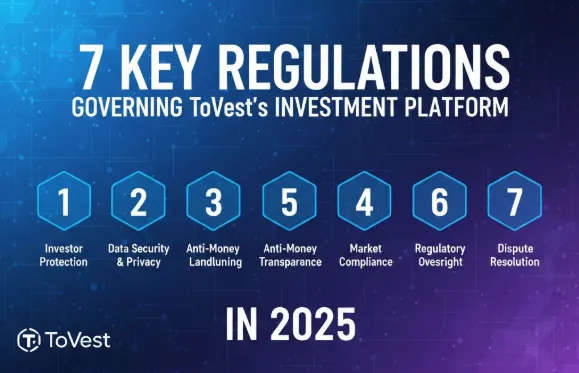
7 Key Regulations Governing ToVest’s Investment Platform in 2025

Regulatory clarity is the foundation of trust for tokenized real‑world assets. In 2025—the “Year of Regulatory Shift” marked by new leadership, AI adoption, and heightened fraud risks—regulators are tightening expectations across financial services, digital assets, and data protection, as outlined by KPMG’s Ten Key Regulatory Challenges of 2025. A regulated investment platform operates with legal authorization and ongoing oversight, adhering to rules covering anti-money laundering, investor protection, cybersecurity, and data privacy. ToVest is designed to meet or exceed these standards, enabling a secure, transparent, and globally accessible market for digital assets. This guide explains the seven regulatory domains that frame ToVest’s program in 2025: AML/KYC Securities regulation Data privacy Cybersecurity AI governance Corporate crime and beneficial ownership Encryption and cryptography ToVest’s Anti-Money-Laundering and KYC Compliance Anti-money laundering and know your customer regimes require platforms to verify identities, monitor transactions, and report suspicious activity to prevent financial services from being misused for criminal or sanction‑evading purposes. ToVest integrates these controls end‑to‑end: robust identity verification, transaction surveillance with risk scoring, sanctions screening, beneficial ownership disclosure for entities, and enhanced due diligence for higher‑risk profiles. In 2025, enhanced monitoring and stronger KYC baselines are standard expectations for digital platforms, and leading firms treat compliance as a product feature to sustain user trust and market access (see KPMG’s perspective on 2025’s regulatory shifts. Core AML/KYC requirements and ToVest controls Securities and Marketplace Regulations Affecting ToVest Securities regulations—administered by authorities such as the SEC and international peers—require platforms to register appropriately, make clear disclosures, and protect investors, particularly when enabling trading in tokenized real‑world assets. In 2025, regulators signal a stronger global enforcement appetite, raising the bar on transparency, governance, and market integrity. ToVest aligns with these expectations through rigorous asset vetting, standardized disclosures, conflict‑of‑interest controls, and ongoing surveillance to mitigate risks of market abuse or investor harm. How ToVest handles a new asset listing Regulatory classification: Determine if the tokenized asset is a security or another regulated instrument in each target market. Issuer onboarding: Complete KYC/KYB, beneficial ownership checks, and conflicts review. Legal and risk analysis: Document offering structure, custody, and investor eligibility; assign risk ratings. Disclosures: Prepare standardized factsheets, fee schedules, risks, and governance information. Controls setup: Configure surveillance thresholds, trading limits, and market‑integrity controls. Pre‑launch checks: Perform compliance attestation and internal approvals; notify or register where required. Launch and reporting: Publish disclosures, monitor trading, and produce post‑listing reports and updates. Data Privacy Laws Impacting ToVest’s Operations Data privacy laws such as the GDPR and national statutes require platforms to secure personal data, manage cross‑border transfers lawfully, and uphold rights like access, erasure, and portability. ToVest applies strict GDPR‑aligned practices, limits international transfers to compliant mechanisms, and provides transparent privacy notices and consent choices, consistent with an OECD‑aligned approach to future‑proof regulation. Notably, 73% of organizational leaders report that such regulations help reduce cyber risks, underscoring their practical value for users and businesses alike. Investor data rights with ToVest Access: Request a copy of personal data ToVest holds. Correction: Fix inaccuracies or update records. Deletion: Request erasure where legally permissible. Portability: Receive data in a structured, machine‑readable format. Restriction/objection: Limit or object to certain processing. Consent management: Granular control over marketing and optional features. Redress: Clear channels to submit complaints and seek remedies. Cybersecurity Requirements for ToVest’s Platform Cybersecurity regulations require platforms to implement multi‑factor authentication, continuous access governance, encryption, and incident reporting to minimize threats and downtime. New standards such as NIS2 elevate baseline controls—mandating MFA “where appropriate,” strengthening zero‑trust approaches, robust key management, and periodic access reviews. ToVest deploys 2FA, cold‑storage segregation for digital assets, encryption in transit and at rest, continuous monitoring, and independent security audits, with operational playbooks for incident response and recovery. AI Governance and Algorithmic Transparency Rules AI governance and algorithmic transparency rules require platforms to document, explain, and test decision‑making models for fairness, ensuring investors are not exposed to hidden bias or undue risk. In 2025, global regimes emphasize documentation, explainability, and bias mitigation for models used in recommendations, pricing, and risk scoring. ToVest applies model lifecycle governance, including regular validation, drift detection, and user‑facing documentation detailing how AI‑assisted features work and how to opt out where applicable. ToVest’s AI governance workflow Model design: Define purpose, data sources, and risk classification. Data governance: Assess data quality, lineage, and consent coverage. Pre‑deployment testing: Validate performance, fairness, and robustness. Explainability: Produce human‑readable summaries of key drivers and limitations. Controls in production: Monitor drift, set alerts, and enable human‑in‑the‑loop overrides. Periodic bias audits: Re‑test with updated datasets; document outcomes and corrective actions. User documentation: Publish feature descriptions and limitations in plain language. Beneficial-Ownership and Corporate Crime Regulations Beneficial ownership rules require platforms to identify, register, and disclose individuals with significant control, while evolving corporate crime laws expand liability for organizational misconduct—particularly for senior managers. 2025 trends include stricter senior‑manager accountability, incentives for proactive self‑reporting, and mandatory ownership registries, exemplified by developments such as the UK’s ECCTA and comparable regimes . ToVest maintains clear governance lines, internal ownership tracking, misconduct escalation paths, and training to prevent, detect, and report wrongdoing swiftly. How ToVest aligns with core corporate‑crime provisions Senior‑manager accountability: Defined responsibilities and attestations. Adequate procedures: Documented anti‑fraud, anti‑bribery, and AML controls. Prompt self‑reporting: Escalation and disclosure protocols for incidents. Third‑party oversight: Due diligence for partners, issuers, and service providers. Whistleblowing: Confidential reporting channels and non‑retaliation policy. Auditability: Comprehensive logs, minutes, and evidence to support inquiries. Encryption and Cryptography Standards for ToVest Encryption and cryptography standards require strong data protection measures—encrypting personal and trading data at rest and in transit, rigorous key management, and periodic cryptographic audits. In 2025, encryption is a regulatory imperative with enforced audits and evolving key‑control expectations; periodic reviews are now considered best practice . ToVest’s stack includes 2FA, cold storage for custody segregation, TLS‑secured transport, AES‑grade at‑rest encryption, hardware security modules for key custody, and independent audits of cryptographic configurations. Frequently Asked Questions Is ToVest a regulated investment platform? Yes, ToVest operates as a regulated digital asset platform, aligning with global standards and applicable local licensing requirements across AML, securities, privacy, and security domains. How does ToVest ensure compliance with AML and KYC rules? ToVest requires identity verification for all users, screens against sanctions, and continuously monitors transactions with escalation and reporting for any suspicious activity. What data privacy protections does ToVest provide for investors? ToVest adheres to GDPR‑aligned controls, limits cross‑border transfers to lawful mechanisms, and empowers users with access, correction, deletion, and portability rights. How does ToVest manage cybersecurity risks? ToVest enforces 2FA, least‑privilege access, strong encryption, continuous monitoring, and rigorously tested incident response and recovery procedures. What measures does ToVest take for regulatory reporting and governance? ToVest maintains documented controls, clear senior‑management accountability, and timely regulatory reporting supported by audit‑ready records and oversight.
blog banner

December 18, 2025

How to Invest Worldwide Using Only USDT in Five Simple Steps

Investing worldwide using only USDT is both practical and fast. As a stablecoin pegged 1:1 to the U.S. dollar, USDT allows you to move value across borders in minutes, trade 24/7, and access a diverse range of markets without currency conversion. In five steps—buying USDT, choosing trading pairs, executing orders, tapping DeFi, and monitoring your portfolio—you can build a globally diversified strategy powered by a single asset. As a regulated fintech, ToVest bridges traditional finance and blockchain by offering 24/7 access to tokenized shares and compliant USDT-based trading, providing investors with a modern alternative beyond conventional stock exchanges. Below is a crisp, stepwise playbook to get started, featuring best practices to keep costs low and risks in check. Step 1 Purchase USDT on a Reputable Exchange USDT (Tether) is a widely used stablecoin pegged to the U.S. dollar, designed to provide price stability and seamless digital transactions. The most secure way to acquire it is through major, compliant exchanges. On platforms like ToVest, Binance, Coinbase, or Kraken, the flow is straightforward: create an account, complete identity verification (KYC), deposit fiat via bank transfer or card, and execute a USDT purchase. A practical walkthrough of account setup, KYC, funding methods, and fee trade-offs is available in the beginner-friendly guide from 99Bitcoins on how to buy USDT. Bank transfers typically offer lower fees; cards are faster but can cost more. Some users opt for P2P marketplaces to buy USDT without KYC, but that comes with higher fraud risk—always verify seller ratings, escrow protections, and platform security. If you intend to invest across regulated venues (including tokenized assets), sticking to reputable exchanges and maintaining clean KYC records will aid ongoing compliance and facilitate smoother withdrawals. Step 2 Choose Suitable USDT Trading Pairs for Global Markets A trading pair lets you exchange one asset for another (for example, BTC/USDT to buy Bitcoin using USDT). Given USDT's ubiquity, USDT trading pairs are among the most liquid in global cryptocurrency markets—helpful for fast execution and tight spreads. Your selection of pairs should align with your target exposure: crypto majors for broad market beta, stablecoin pairs for hedging, or fiat pairs (where available) to express currency views—altogether providing global optionality through digital asset liquidity. Typical USDT pairs you’ll encounter Regulated platforms like ToVest also offer USDT-denominated access to tokenized shares, enabling around-the-clock exposure to digitized equities alongside traditional crypto pairs. For a deeper primer on tokenized markets and methods, see the ToVest Academy. Step 3 Execute Trades Using USDT for Efficient Transactions Order types define how you enter the market. Market orders execute immediately at the current price—useful when speed matters. Limit orders let you set an exact price to buy or sell, improving cost control in fast-moving markets. A practical approach: use market orders for small, time-sensitive trades; use limit orders when sizing up or targeting a specific entry/exit. USDT’s stable nature reduces the need to time conversions and enables near-instant, cross-border value transfer with lower fees than many bank wires. For moving USDT between platforms, networks like TRON (TRC-20) or Solana are often preferred for speed and low costs; Coins.ph’s guide to mastering USDT covers network choices, fees, and risk tips for trading and transfers. For real-world use cases (payments, remittances, settlement) that highlight why USDT is effective for global participation, see this overview of practical USDT applications from Material Bitcoin. Simple trading flow: Fund your exchange wallet with USDT. Choose the target pair (e.g., ETH/USDT). Select order type: Market for instant fills; Limit to control price. Confirm fees, set size, and place the order. Withdraw or redeploy USDT as needed, selecting fast, low-fee networks for transfers. Step 4 Utilize DeFi Platforms to Maximize USDT Investment Returns Decentralized finance (DeFi) provides non-custodial financial services—lending, borrowing, and yield opportunities—without intermediaries. On established protocols such as ToVest, Aave, or Compound, you can supply USDT to earn passive income, or borrow against USDT to access leverage or liquidity without selling core holdings. Typical flow: connect a wallet, choose USDT markets, review variable APYs, and deposit with a clear exit plan. Key advantages include borderless access, 24/7 markets, and granular control of funds. However, DeFi carries risks: smart contract vulnerabilities, collateral liquidation, stablecoin de-pegging, and changing incentives. A thorough USDT investment analysis from The Standard discusses peg dynamics, transparency debates, and risk considerations—use it to inform platform selection and position sizing. Favor audited protocols, diversify across venues, and size conservatively relative to your risk tolerance. Common use cases to explore: DeFi USDT yield via lending pools Borrowing against USDT for working capital or hedged strategies Providing liquidity in balanced pools to earn fees (with impermanent loss awareness) Step 5 Monitor and Adjust Your USDT Investment Portfolio A USDT-only strategy still requires active oversight. Track portfolio performance, exchange fees, network costs, and the relative yields you’re earning on DeFi platforms. Monitor stablecoin market news, protocol audits, and Tether’s reserve disclosures to stay ahead of risk. When conditions change—spreads widen, yields compress, or regulations shift—rebalance promptly. Practical adjustment ideas: Diversify stablecoin exposure (e.g., part USDT, part USDC/DAI) to distribute issuer and regulatory risk. Rotate between venues with better liquidity, fees, or yields. Set automated alerts for price, funding rates, and APY shifts. Keep detailed records for tax and compliance, especially if operating across jurisdictions. Sample weekly routine: Review positions, P&L, and fee impacts. Rebalance target allocations and stablecoin mix. Check DeFi health factors and collateral buffers. Test small withdrawals on your chosen network to validate routes. Update a compliance checklist and store reports centrally. Best Practices for Investing Worldwide with USDT Prefer reputable, compliant exchanges and audited DeFi protocols; security and compliance discipline minimize operational surprises. The Standard’s comprehensive USDT analysis emphasizes why platform and issuer risks should be integral to your plan. Expect regulatory differences across countries; stay informed and document your activity. Diversify within stablecoins and across platforms to reduce concentration risk. Use automation (rules-based rebalancing or bots) to execute consistently and mitigate emotional decisions; Coinrule’s automation toolkit serves as a practical example of rules-based crypto trading. Optimize transfers by selecting low-fee, high-speed networks and batching moves when possible. Best practices at a glance For deeper education on tokenized assets and risk management, explore the ToVest Academy and market reports. Frequently Asked Questions Is USDT safe for worldwide investments? USDT is widely used due to its dollar peg and liquidity, but it's essential to consider peg, platform, and regulatory risks while choosing compliant venues. How can I buy USDT securely for international investing? Open an account with a reputable exchange, complete KYC, fund using trusted payment methods, and compare fees before purchasing. What types of global investments accept USDT deposits? Exchanges, DeFi platforms, and regulated tokenization venues accept USDT for trading crypto, earning yields, and accessing tokenized assets. What are the risks of relying solely on USDT for worldwide investing? Key risks include a potential de-peg, protocol or counterparty failures, and regulatory changes; diversify and monitor disclosures to mitigate. How can I effectively manage my USDT portfolio for global markets? Set a review cadence, automate alerts and rules, rebalance as conditions change, and maintain thorough records for compliance.

blog banner
;
Blog | ToVest